Wednesday, March 30, 2022

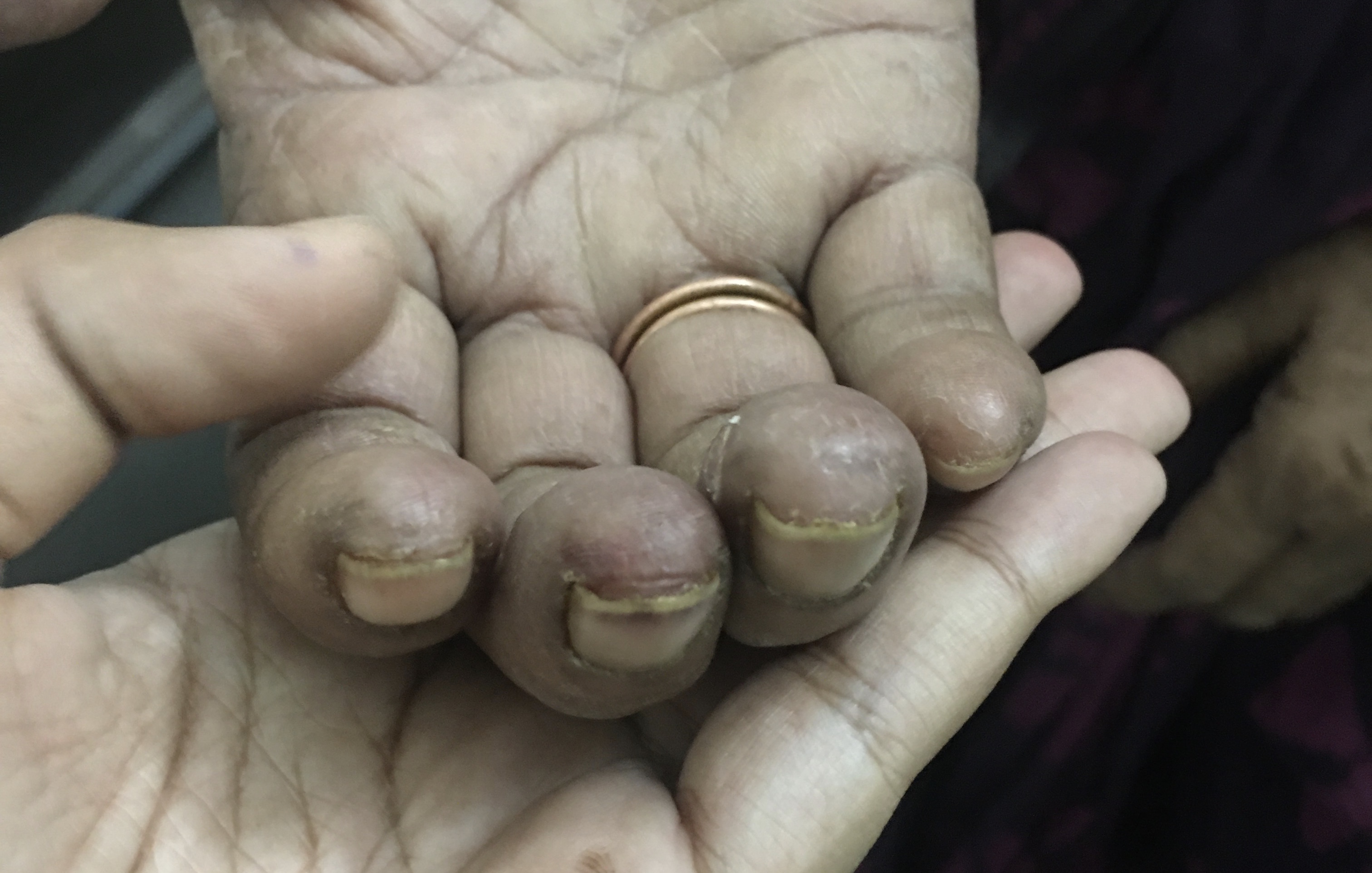
63 year old with pain in the right upper limb distal phalanges and dysphagia


This is online E log book to discuss our patient’s de-identified health data shared after taking his/her/guardian’s signed informed consent. Here we discuss our individual patient’s problems through series of inputs from available global online community of experts with an aim to solve those patients’ clinical problems with collective current best evidence-based inputs. 


This e-log book also reflects my patient centred online learning portfolio and your valuable inputs on comment box is welcome


I’ve been given this case to solve in an attempt to understand the topic of “patient clinical data analysis" to develop my competency in reading and comprehending clinical data including history, clinical findings, investigations, and come up with diagnosis and treatment plan.


 A 63 year old female, resident of chittiyala and a milkmaid by occupation came to the OPD with the chief complaints of 


  • Dryness of mouth and inability to swallow since 2 months
  • Ear pain and ringing sensation in ears on and off since 2 months 
  • Pain in the right distal phalanges since 2 months
  • History of dizziness since 10days 

HISTORY OF PRESENTING ILLNESS 


The patient had a stroke at 5 months of age after which she had deviation of angle of mouth for which she took herbal medication. 


 3 years back when she had a pain in the left lower limb which was associated with redness and swelling. This was attributed to a insect but . She was taken to the hospital and on evaluation she was diagnosed with diabetes. 

She was given medication and is compliant with the medication till date. She gets her blood sugar monitored every 2 months. 


She complains of difficulty in swallowing since 2 months. Initially it was associated with burning type of pain for which she went to the hospital and was diagnosed with acute pharygo-larygitis and glossitis. 

She was prescribed medication for the same. The burning sensation in the mouth reduced but dysphagia remained the same. 


15 days after this she complained of pain and ringing sensation in the right ear. Not associated with loss of hearing, discharge from the ear, fever. She was taken to the hospital and was prescribed medication. The pain reduced but tinnitus is intermittent in nature. 


5 days after this episode she complains of pain and bluish discolouration of the right upper limb distal phalanges. The pain is of pricking type and is relieved on taking pain medication (unknown) 


PERSONAL HISTORY 


  • Diet: mixed
  • Appetite: Normal
  • Bowel: normal 
  • Bladder : normal 
  • Sleep: disturbed 
  • Addictions: nil 
  • Allergies (food/drugs) : nil 

GENERAL EXAMINATION


Patient is conscious, coherent and co-operative; well oriented to time, person, place.


Well built and well nourished.

Pallor present.

No icterus, clubbing, cyanosis, edema, generalised lymphadenopathy.


VITALS:

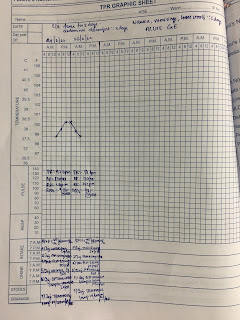
  • PR: 90bpm
  • BP: 110/70mmHg
  • RR: 16cpm
  • Temperature: Afebrile


Investigations: 


RBS: 164 mg/dl


Se. Creatinine: 1.2 mg/dL

Se. Uric acid: 11.1 mg/dL

Blood urea: 41 mg/dL


Na: 138 mEq/L

K: 4.8 mEq/L

Cl: 101 mEq/L


LFT: 

Db: 0.16  mg/dL

Tb: 0.57  mg/dL

AST: 64 IU/L

ALT: 57 IU/L

ALP: 204  IU/L

TP: 8.0 gm/dL

Albumin: 3.6 gm/dL

A/G ratio: 0.89


Provisional Diagnosis:

Critical limb ischaemia 

Raynaud's phenomenon ?


Treatment plan:

1. Tab. NIFEDIPINE 10mg TID 

2. IV FLUIDS 2 NS 

3. Inj. ACTRAPID 10 units 

(Morning- afternoon-night)

4. Tab. FOLITRAX 7.5mg once a week 

Every Wednesday 

5. Tab.FOLIC ACID 5mg once a week on Tuesday.


Tuesday, March 29, 2022

60 year old male with SOB and edema


 This is online E log book to discuss our patient’s de-identified health data shared after taking his/her/guardian’s signed informed consent. Here we discuss our individual patient’s problems through series of inputs from available global online community of experts with an aim to solve those patients’ clinical problems with collective current best evidence-based inputs. 

This e-log book also reflects my patient centred online learning portfolio and your valuable inputs on comment box is welcome

I’ve been given this case to solve in an attempt to understand the topic of “patient clinical data analysis" to develop my competency in reading and comprehending clinical data including history, clinical findings, investigations, and come up with diagnosis and treatment plan.


A 60 year old man, resident of yedadri district and a palm tree climber by occupation, presented to the hospital with the chief complaints of 

  • shortness of breath since 6 months 
  • Pedal edema since 10 days 


HISTORY OF PRESENTING ILLNESS 


The patient was apparently asymptomatic 10 years back when he had an episode of dizziness for which he went to a doctor and was diagnosed with hypertension. 

The patient was prescribed medication (Cilnidipine) and he is compliant with the medication till date. 


The patient has had complaints of shortness of breath since 6 months. It was initially of class 2 NYHA classification (ordinary physical activity results in SOB) and progressed to class 3 NYHA (less than ordinary activity results in SOB). He complains of decreased urine output since 6 months. For which he went to a doctor and was prescribed furesamide. He is compliant with the medication. No other information is available with the patient regarding that visit.   


He also has orthopnea and PND. 


He has had pedal edema since 10 days which was initially till his ankle joint now involves his entire lower limb as well his upper limbs. 


He doesn’t have any complaints of palpitations, chest pain, sweating, cough, fever, burning micturition, loin pain, hematuria. 


Past history 

He was diagnosed with HTN 10 years back. 

He is not a known case of DM, HTN coronary artery diseases, Asthma, TB, epilepsy. 

No similar complaints in the past 


PERSONAL HISTORY 


  • Diet: mixed
  • Appetite: Normal
  • Bowel: normal 
  • Bladder : decreased urine output since 6 months 
  • Sleep: disturbed 
  • Addictions: he used to smoke 1 packet of biddis (15years - 50 years). He used to drink 2 bottles of toddy per day. He stopped drinking toddy when his SOB started i.e. 6 months ago. 
  • Allergies (food/drugs) : nil 


Daily routine : 

He wakes up at 6:00 everyday. He brushes his teeth and take a bath and then he has breakfast. He is done with his morning routine by 8:00am. He then takes rest and watches TV. he has lunch at 1:30pm. Following which he takes an afternoon nap. He wakes up at 4:00 and has snacks. He has dinner at 8:30 and sleeps at 9:30 after watching news. 


GENERAL EXAMINATION


Patient is conscious, coherent and co-operative; well oriented to time, person, place.


Well built and well nourished.


Pedal edema, pitting type throughout leg upto hip. Pitting type edema over his Right hand upto his shoulder. Mild pitting edema over left hand as well. 


Pallor present.


No icterus, clubbing, cyanosis, generalised lymphadenopathy.


VITALS:
  • PR: 92bpm
  • BP: 140/90mmHg
  • RR: 18 cpm
  • Temperature: Afebrile


CARDIOVASCULAR SYSTEM: 

On palpation,

-Apex beat was diffuse

-JVP not raised

-No precordial bulge 

-No parasternal heave

On auscultation, S1, S2 heard; no murmurs


RESPIRATORY SYSTEM


INSPECTION: 

bilaterally symmetrical

Expansion of chest: Equal on both sides

Position of trachea: Central

Supraclavicular and infraclavicular areas normal

Spinoscapular distance normal

No crowding of ribs 

No visible scars, sinuses, pulsations


PALPATION:

Inspectory findings confirmed

No tenderness, local rise of temperature

Normal expansion of chest on both sides in all areas

Chest diameter: 5:7

Position of trachea: Central

Vocal fremitus: resonant note felt


PERCUSSION:

Resonant note heard over all areas


AUSCULTATION:

crepts heard over all lung fields

Vocal resonance: resonant in all areas


PER ABDOMINAL EXAMINATION:

Soft, non-tender

No hepato-splenomegaly noted


CNS

HIGHER MENTAL FUNCTIONS- 

Normal

Memory intact


CRANIAL NERVES :Normal


SENSORY EXAMINATION

Normal sensations felt in all dermatomes


MOTOR EXAMINATION

Normal tone in upper and lower limb

Normal power in upper and lower limb

Normal gait


REFLEXES

Normal, brisk reflexes elicited- biceps, triceps, knee and ankle reflexes elicited


CEREBELLAR FUNCTION

Normal function


No meningeal signs were elicited


EVALUATION

Hb: 9.1gm%

Serum creatinine : 10mg/dL (0.9-1.3mg/dL)

Blood urea : 132mg/dL (12-42mg/dL)

ELECTROLYTES 

Serum sodium : 134 mEq/L (136-145 mEq/L) 

Serum potassium : 3.4 mEq/L(3.5-5.1 mEq/L)

Serum chloride : 98 mEq/L (98-107 mEq/L)

2D ECHO


USG


TREATMENT : 

Tab. LASIX 40 mg  PO TID

Tab. PAN 40mg PO OD

Tab. NODOSIS 50mg PO OD

Tab. SHELCAL PO OD

Inj. EPO 4000IU Weekly once 

Tab. NICARDIA 10mg PO OD


Discussion:


Sunday, February 27, 2022

A 37 year old with shortness of breath and pedal edema

This is online E log book to discuss our patient’s de-identified health data shared after taking his/her/guardian’s signed informed consent. Here we discuss our individual patient’s problems through series of inputs from available global online community of experts with an aim to solve those patients’ clinical problems with collective current best evidence-based inputs. 


This e-log book also reflects my patient centred online learning portfolio and your valuable inputs on comment box is welcome


I’ve been given this case to solve in an attempt to understand the topic of “patient clinical data analysis" to develop my competency in reading and comprehending clinical data including history, clinical findings, investigations, and come up with diagnosis and treatment plan.


A 37 year old male, resident of yedadri district and a centring worker by occupation, came to the OPD with the chief complaints of 

  • Shortness of breath since 3 months 
  • Pedal edema since 15 days 


HISTORY OF PRESENTING ILLNESS :


The patient was apparently asymptotic 3 years ago when he had fever and an episode of giddiness for which he went to the hospital and was diagnosed with hypertension. 

The patient was given telmasartan and was sent home.


 The patient took the medicine for few days but stopped as his relatives and friends told him not to take hypertension medication that early in life as it might lead to problems. 

He used to experience neck pain during some days for which he takes the hypertensive medication apart from that he is not compliant with the medication. 


Patient gives a history of shortness of breath (grade 2 MMRC) and chest pain 3 months back. The chest pain was of stabbing type and was only felt on moving from side to side or bending forward. It was also associated with a swelling over the left side of the chest (left mammary region). For this, he went to the doctor and was given medication. His complaints of pain and swelling  were relieved in 3 days. 

The shortness of breath was not relieved. 


The patient gives history of fever 20 days back which was associated with burning micturition. The fever was of low grade and was intermittent in nature. It was associated with chills and rigor. He has had significant weight loss (the patient’s waist size decreased from 32 to 28 in the span of one month.)


He complains of pedal edema since 15 days. It initially extended till his ankle. Presently it extends up till his knee. 

The shortness of breath has increased to grade 3 MMRC in the last one month due to which he stopped working. 5 days back his SOB increased to grade 4 MMRC. 


PAST HISTORY 


He is not a known case of DM, coronary artery diseases, Asthma, TB, epilepsy. 


PERSONAL HISTORY 


  • Diet: mixed
  • Appetite: Reduced
  • Bowel: normal 
  • Bladder : burning micturition 
  • Sleep: disturbed 
  • Addictions: he has been consuming 90ml of whiskey everyday for the past 15 years. He has been smoking 2 cigarettes per day for the past 15 years. He also chews ghutka.
  • Allergies (food/drugs) : nil 


GENERAL EXAMINATION 


  •   The patient if conscious, coherent and cooperative 
  • He is Moderately built and moderately nourished
  • Pallor is present 
  • Edema upto the knee joint is seen. It is of pitting type. 
  • NO icterus, clubbing, cyanosis, generalised lymphadenopathy  is seen 


VITALS:

  • PR: 90bpm
  • BP: 150/100mmHg
  • RR: 18 cpm
  • Temperature: Afebrile


SYSTEMIC EXAMINATION 


CVS


  • On palpation,

-Apex beat was diffuse and was felt at 6th intercostal space lateral as well as medial to mid-clavicular line. 

-JVP was raised 

-No precordial bulge 

  • parasternal heave was felt 
  • On auscultation
  • S1, S2 heard; no murmurs were heard 


ABDOMINAL EXAMINATION:

The abdomen is scaphoid. 

Tenderness was noticed just below the sternum. 

There is no local raise of temperature. 

There was no organomegaly. 


RESPIRATORY SYSTEM: 

Bilateral air entry was present. 

Vesicular breath sounds were heard. 


CNS

No functional deficits were noticed. 


 X-ray: 

Mild pleural effusion and prominent right descending pulmonary artery 

Cardiomegaly 


ECG: 

left ventricular hypertrophy


FUNDOSCOPY: 

Right eye and left eye show grade 1 hypertensive retinopathy changes. 


ULTRASOUND ABDOMEN AND PELVIS:

B/L grade 3 parenchyma disease and mild ascites was seen. 


CUE 

- Albuminuria present

24 hr UPCR sent 

24 hr urinary protein - 1,190 mg/day

24 hr urinary sodium- 227 mmol/day

24 hr urine volume 1300ml

Serum Uric acid- 7.5 mg%

Serum electrolytes Na - 140, Cl 106, K+ 5

Serum creatinine- 5.6 mg/dl

Serum calcium- 9mg/dl

Blood urea - 119 mg/dl


2D echo

All chambers are dilated. 

Thursday, February 24, 2022

A 27 year old with abdominal pain


 This is online E log book to discuss our patient’s de-identified health data shared after taking his/her/guardian’s signed informed consent. Here we discuss our individual patient’s problems through series of inputs from available global online community of experts with an aim to solve those patients’ clinical problems with collective current best evidence-based inputs. 


This e-log book also reflects my patient centred online learning portfolio and your valuable inputs on comment box is welcome


I’ve been given this case to solve in an attempt to understand the topic of “patient clinical data analysis" to develop my competency in reading and comprehending clinical data including history, clinical findings, investigations, and come up with diagnosis and treatment plan.


A 27 year old male patient, who is a driver by occupation and a resident of Chityala came with the chief complaints of 

Abdominal pain since 5 days 

Nausea and committing since 5 days. 


The patient was apparently asymptotic 10 years back. He started drinking at an age of 17 years. He had his first drink (toddy) in a function that he attended. At that time he consumed 2 bottles of toddy. The patient gives history that he faced similar complaints back then that is abdominal pain, nausea and vomiting. For which he was taken to the hospital and was treated. 


Later the patient started drinking occasionally usually with his friends or during festivals (1 bottle)


10 days before the symptoms started the patient gives a history of drinking 1-2 bottle of toddy everyday as it was someone’s wedding/ function.  The day after drinking he would wake up with a hangover and drink 1/4 bottle of toddy to get relieved from the symptoms. 5 days ago the patient gives history of going to a  wedding where he ate “masala rice” and drank 2 bottles of toddy. 

6 hours after this he started experiencing abdominal pain in the epigastric and the umbilical region. The pain was sudden in onset and constant throughout the time. There were no aggravating or relieving factors as such. 


The patient also complains of nausea and vomiting. He has had a vomiting episode everytime he has tried to consume food. 

He also had FEVER which was  low-grade,  intermittent , associated with burning micturition but not associated with chills& rigors cold , cough,  weakness ,joint pains


As his symptoms were not subsiding he went to a hospital in nalagonda, where he was given symptomatic treatment. And was put on NBM. 


He has had 2 loose stool of day 3 and day 4 of symptoms. 


As the patient’s condition was not improving they shifted to our hospital. 


PAST HISTORY 

He is not a known case of DM, HTN coronary artery diseases, Asthma, TB, epilepsy. 


PERSONAL HISTORY 

Diet: mixed

Appetite: NIL 

Bowel: normal 

Bladder : normal

Sleep: disturbed 

Addictions: consumes toddy 

Allergies (food/drugs) : nil 


GENERAL EXAMINATION 

  •   The patient if conscious, coherent and cooperative 
  • He is Moderately built and moderately nourished 
  • NO signs of pallor, icterus, clubbing, cyanosis, generalised lymphadenopathy, pedal edema  is seen 


VITALS:

  • PR: 90bpm
  • BP: 110/70mmHg
  • RR: 18 cpm
  • Temperature: 99.4°F


PER ABDOMINAL EXAMINATION :


On inspection : 

The abdomen is scaphoid in shape. The umbilicus was central in position and inverted. 

There were no visible peristalsis, engorged veins, discoloured skin over the abdomen.  


On palpation :

Tenderness is  noted. Muscle guarding is present. 

There is no organomegaly. 

No signs of ascites. 


On auscultation: 

Decreased bowel sounds were heard. 


Respiratory system examination

Bilateral air entry was present. 

Normal vesicular breath sounds were heard. 


CVS

S1 and S2 are heard. 

No abnormal heart sounds were heard. 


CNS:

No fuctional deficits were noticed. 


TREATMENT

IVF : NS , RL @ 100ml/hr 

INJ. ZOFER 4mg IV /BD

INJ.PANTOP 40mg IV/BD

INJ.PCM 650mg po/TID 

INJ.NEOMOL 1g sos(if temp >101 f ) 

INJ. OPTINEURON 1amp in 100ml NS IV/BD

INJ. TRAMADOL 1amp in 100ml NS IV/BD

General medicine Internship Real patient OSCE towards optimising clinical complexity

This online E-log Entry Blog is an objectively structured clinical examination method to assess the clinical competence during the course of...